Telecommunication
Connecting people. Empowering communities.
About this SERVICE
Building Connections That Matter
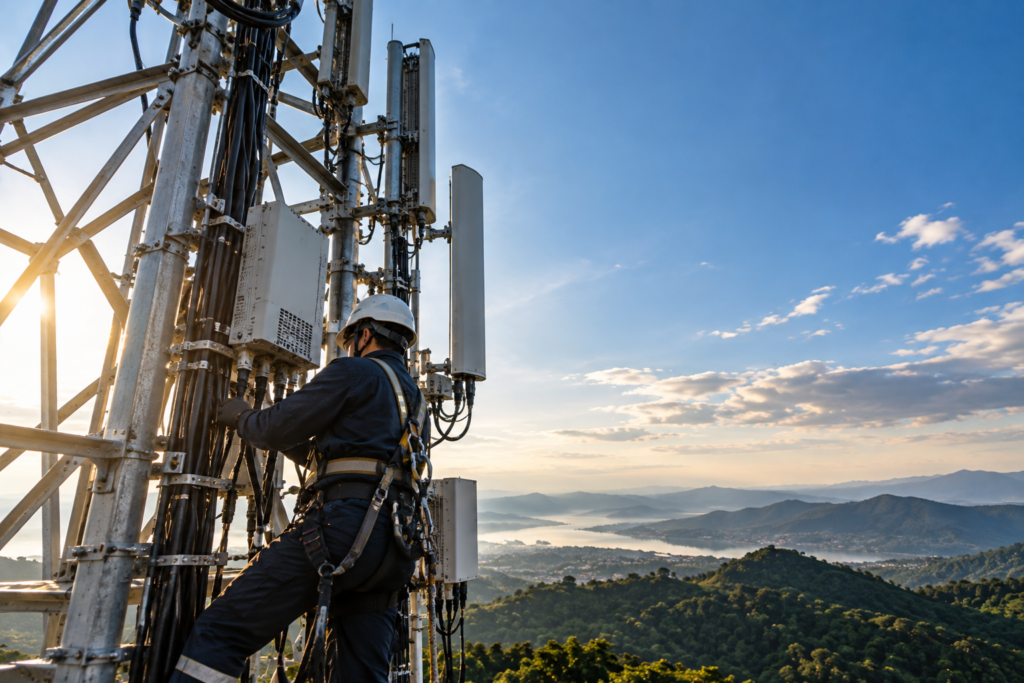
Telecommunication is more than just technology — it is the infrastructure that connects people, businesses and communities. From mobile networks and internet connectivity to enterprise communication systems, reliable infrastructure enables people and organisations to communicate, grow and operate effectively.
At ELD Solution, we take a practical and long-term approach to every project. We work closely with our clients to understand their requirements, develop suitable solutions and ensure that each project is delivered with attention to quality, reliability and performance.

OUR APPROACH
Building Connections That Matter
Telecommunication is more than just technology — it is the infrastructure that connects people, businesses and communities. From mobile networks and internet connectivity to enterprise communication systems, reliable infrastructure enables people and organisations to communicate, grow and operate effectively.
At ELD Solution, we take a practical and long-term approach to every project. We work closely with our clients to understand their requirements, develop suitable solutions and ensure that each project is delivered with attention to quality, reliability and performance.
OUR WORK AND ACHIEVEMENTS
PROJECT STORIES IN THIS FIELD
Project story 1
August 2026 | Meghalaya, India
Improving Connectivity in Remote Communities

In late 2024, Global Connect Telecom launched Project Horizon, an ambitious multi-national infrastructure overhaul aimed at modernizing aging transoceanic subsea fiber-optic cable landing stations and core routing nodes. The initiative was designed to address severe bandwidth bottlenecks driven by the explosive growth of edge computing, cloud-native enterprise services, and high-density video streaming across North America and Western Europe. By replacing legacy Dense Wavelength Division Multiplexing (DWDM) equipment with state-of-the-art coherent optical transponders, the project sought to dramatically scale backhaul capacity without the exorbitant costs of laying new physical underwater cables.
Executing Project Horizon required a seamless, multi-phased deployment strategy across seven international landing facilities while maintaining continuous network availability. The project team orchestrated complex hot-swaps of optical line systems, implemented unified open-API network management software, and integrated advanced AI-driven telemetry for real-time fault detection. Overcoming severe logistics constraints, strict maritime regulatory compliance, and tight maintenance windows during low-traffic overnight hours, engineering teams migrated high-volume carrier traffic across redundant paths with zero unplanned downtime for downstream enterprise clients.
The achievements of Project Horizon transformed the carrier’s operational landscape. Total network throughput surged from 8 Tbps to an unprecedented 32 Tbps per fiber pair, effectively quadrupling capacity while reducing power consumption per bit by 42%. Additionally, automated optical routing shortened transatlantic round-trip latency to sub-35 milliseconds, while maintaining 99.999% carrier-grade uptime. Beyond immediate metrics, the upgraded infrastructure laid a robust foundation for future 800G and 1.2T wavelength deployments, securing the operator’s position as a market leader and enabling ultra-reliable, high-speed connectivity for millions of end-users worldwide.
Project story 2
July 2026 | Meghalaya, India
Improving Connectivity in Remote Communities
In late 2024, Global Connect Telecom launched Project Horizon, an ambitious multi-national infrastructure overhaul aimed at modernizing aging transoceanic subsea fiber-optic cable landing stations and core routing nodes. The initiative was designed to address severe bandwidth bottlenecks driven by the explosive growth of edge computing, cloud-native enterprise services, and high-density video streaming across North America and Western Europe. By replacing legacy Dense Wavelength Division Multiplexing (DWDM) equipment with state-of-the-art coherent optical transponders, the project sought to dramatically scale backhaul capacity without the exorbitant costs of laying new physical underwater cables.
Executing Project Horizon required a seamless, multi-phased deployment strategy across seven international landing facilities while maintaining continuous network availability. The project team orchestrated complex hot-swaps of optical line systems, implemented unified open-API network management software, and integrated advanced AI-driven telemetry for real-time fault detection. Overcoming severe logistics constraints, strict maritime regulatory compliance, and tight maintenance windows during low-traffic overnight hours, engineering teams migrated high-volume carrier traffic across redundant paths with zero unplanned downtime for downstream enterprise clients.
The achievements of Project Horizon transformed the carrier’s operational landscape. Total network throughput surged from 8 Tbps to an unprecedented 32 Tbps per fiber pair, effectively quadrupling capacity while reducing power consumption per bit by 42%. Additionally, automated optical routing shortened transatlantic round-trip latency to sub-35 milliseconds, while maintaining 99.999% carrier-grade uptime. Beyond immediate metrics, the upgraded infrastructure laid a robust foundation for future 800G and 1.2T wavelength deployments, securing the operator’s position as a market leader and enabling ultra-reliable, high-speed connectivity for millions of end-users worldwide.
Project story 3
June 2026 | Meghalaya, India
Improving Connectivity in Remote Communities
In late 2024, Global Connect Telecom launched Project Horizon, an ambitious multi-national infrastructure overhaul aimed at modernizing aging transoceanic subsea fiber-optic cable landing stations and core routing nodes. The initiative was designed to address severe bandwidth bottlenecks driven by the explosive growth of edge computing, cloud-native enterprise services, and high-density video streaming across North America and Western Europe. By replacing legacy Dense Wavelength Division Multiplexing (DWDM) equipment with state-of-the-art coherent optical transponders, the project sought to dramatically scale backhaul capacity without the exorbitant costs of laying new physical underwater cables.
Executing Project Horizon required a seamless, multi-phased deployment strategy across seven international landing facilities while maintaining continuous network availability. The project team orchestrated complex hot-swaps of optical line systems, implemented unified open-API network management software, and integrated advanced AI-driven telemetry for real-time fault detection. Overcoming severe logistics constraints, strict maritime regulatory compliance, and tight maintenance windows during low-traffic overnight hours, engineering teams migrated high-volume carrier traffic across redundant paths with zero unplanned downtime for downstream enterprise clients.
The achievements of Project Horizon transformed the carrier’s operational landscape. Total network throughput surged from 8 Tbps to an unprecedented 32 Tbps per fiber pair, effectively quadrupling capacity while reducing power consumption per bit by 42%. Additionally, automated optical routing shortened transatlantic round-trip latency to sub-35 milliseconds, while maintaining 99.999% carrier-grade uptime. Beyond immediate metrics, the upgraded infrastructure laid a robust foundation for future 800G and 1.2T wavelength deployments, securing the operator’s position as a market leader and enabling ultra-reliable, high-speed connectivity for millions of end-users worldwide.
Project story 4
May 2026 | Meghalaya, India
Improving Connectivity in Remote Communities
In late 2024, Global Connect Telecom launched Project Horizon, an ambitious multi-national infrastructure overhaul aimed at modernizing aging transoceanic subsea fiber-optic cable landing stations and core routing nodes. The initiative was designed to address severe bandwidth bottlenecks driven by the explosive growth of edge computing, cloud-native enterprise services, and high-density video streaming across North America and Western Europe. By replacing legacy Dense Wavelength Division Multiplexing (DWDM) equipment with state-of-the-art coherent optical transponders, the project sought to dramatically scale backhaul capacity without the exorbitant costs of laying new physical underwater cables.
Executing Project Horizon required a seamless, multi-phased deployment strategy across seven international landing facilities while maintaining continuous network availability. The project team orchestrated complex hot-swaps of optical line systems, implemented unified open-API network management software, and integrated advanced AI-driven telemetry for real-time fault detection. Overcoming severe logistics constraints, strict maritime regulatory compliance, and tight maintenance windows during low-traffic overnight hours, engineering teams migrated high-volume carrier traffic across redundant paths with zero unplanned downtime for downstream enterprise clients.
The achievements of Project Horizon transformed the carrier’s operational landscape. Total network throughput surged from 8 Tbps to an unprecedented 32 Tbps per fiber pair, effectively quadrupling capacity while reducing power consumption per bit by 42%. Additionally, automated optical routing shortened transatlantic round-trip latency to sub-35 milliseconds, while maintaining 99.999% carrier-grade uptime. Beyond immediate metrics, the upgraded infrastructure laid a robust foundation for future 800G and 1.2T wavelength deployments, securing the operator’s position as a market leader and enabling ultra-reliable, high-speed connectivity for millions of end-users worldwide.